
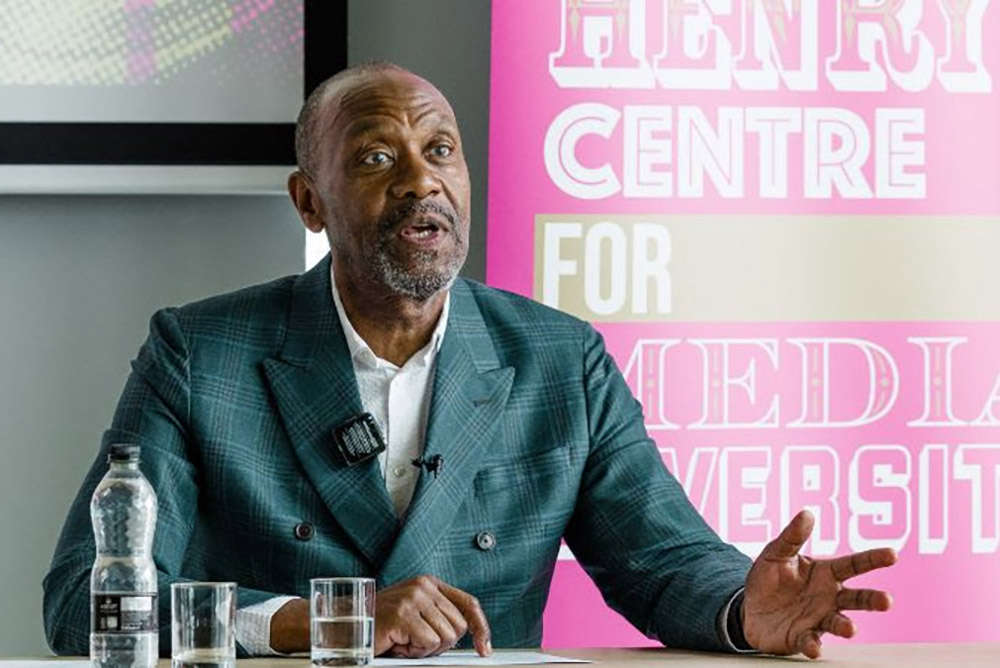
Sir Lenny Henry has called on the UK media industry to confront racism, sexism, ableism and inequality head-on, warning that retreating from conversations about diversity risks weakening both journalism and democracy.
Delivering his second annual lecture for the Sir Lenny Henry Centre for Media Diversity, he addressed an audience of around 60 media leaders, journalists, campaigners, university partners and industry stakeholders.
In a wide-ranging speech, the former Chancellor of Birmingham City University argued that growing hostility towards diversity, equity and inclusion initiatives has led many organisations to soften their language around inequality rather than tackle it directly.
"Words matter," Sir Lenny said. "Sometimes, when words disappear, justice disappears with them."
The award-winning comedian, actor, writer, broadcaster and diversity campaigner challenged the increasing use of the acronym ‘DEI’, arguing that it risks reducing complex issues of representation, power and belonging into a simplified corporate concept that can be more easily dismissed.
"Before it was DEI, it was diversity - who is in the room; equity - who has power; and inclusion - who actually belongs. Three different ideas. Three different struggles. Three different fights."
Drawing on research published by the Sir Lenny Henry Centre for Media Diversity, Sir Lenny highlighted findings from a study - led by ITV News Global Security Editor Rohit Kachroo and Dr Ellie Tomsett - into the experiences of journalists of colour in UK newsrooms.
The research found that 63% of respondents had experienced racism in their workplace, while 70% reported insufficient opportunities for career progression.
"The report didn't call it a DEI issue," Sir Lenny said. "It called it what it felt like. It described 'apartheid' in newsrooms. And suddenly people paid attention."
He also warned that global trends, particularly in the United States, are influencing conversations in the UK.
Referencing recent corporate research showing a significant decline in the use of terms such as diversity, equity and inclusion, Sir Lenny argued that organisations are increasingly avoiding language that directly addresses discrimination.
"Opportunities are narrowing,” he said. “Conversations are becoming more cautious. Organisations are stepping back. Sometimes it doesn't look like a dramatic rollback. Sometimes it looks like silence."
While acknowledging the work of diversity professionals and campaigners across the media sector, Sir Lenny praised those driving change and urged senior leaders to take greater responsibility.
"You are heroes," he told those involved in diversity and inclusion work. "You've made and continue to make a difference for us all. But this can't just be left on your shoulders."
He also highlighted the importance of independent research and evidence gathering, expressing concern about reduced capacity for diversity research across higher education and the media industry.
"We are trying to fight inequality with less evidence," he said.
The lecture concluded with a call for collective action across the industry.
"The problem isn't DEI," Sir Lenny said. "The problem is racism. The problem is sexism. The problem is ableism. The problem is homophobia. The problem is power.
"We are in a fight for the heart and soul of our society. We are in a fight for who tells our stories, who gets heard, and who gets to shape the story of this country."
The event included with a panel discussion featuring Sir Lenny and Centre co-founders Professor Diane Kemp and Marcus Ryder MBE, who reflected on the themes of the lecture and responded to questions from an audience of media executives, journalists, activists and university partners.
The Sir Lenny Henry Centre for Media Diversity, based at BCU, conducts research and works with industry partners to improve representation and inclusion across the UK media sector.











Comments
Add a comment