
West Midlands Ambulance Service is supporting Deaf Awareness Week to challenge misconceptions and provide practical advice on communicating with people who are deaf or hard of hearing.
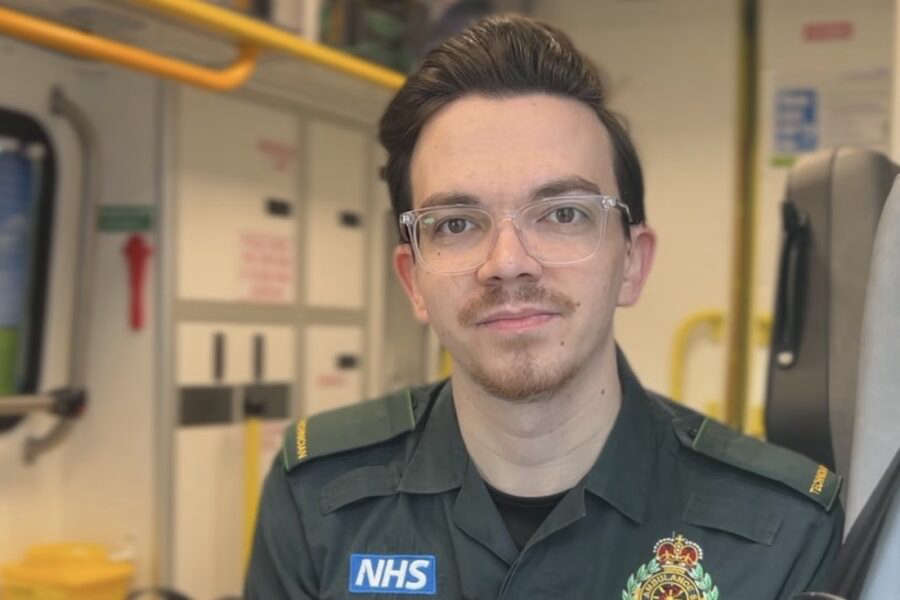
Two members of staff, Stacey Powell and Josh Dovey, have shared their personal experiences of working in frontline ambulance roles while being deaf. Their stories are featured on the Trust’s social media channels helping raise awareness and inspire others.
Stacey, a supervisor in the 999 Emergency Operations Centre in Brierley Hill, has been partially deaf since childhood and has worn bilateral hearing aids for the past three years. She said: “Whilst being deaf can seem very daunting in a job that’s primarily listening to people, I’ve received nothing but support.
"The Trust has provided me with a kit to use with my hearing aids so I can Bluetooth my hearing aids to hear patients directly through them.”
Josh, a technician training to be a paramedic at Sandwell hub, was diagnosed deaf at the age of three. He wears bilateral hearing aids too and highlights the technology that supports him in his role: “One of the things the Trust has provided for me is a Bluetooth stethoscope and it allows me to complete assessments like any other ambulance crew would.
"I also have a Roger receiver which is a microphone which connects to my hearing aid that can block out background noise and allows me to hear the patient directly.”
As part of Deaf Awareness Week, the Trust is addressing common myths about deafness. Stacey added: “There are assumptions that people who wear hearing aids can’t hear anything at all, but in my case I can.
"Without my hearing aids I mis-hear a lot of things and with a lot of background noise that can make hearing difficult.
"Lots of people also assume that people who are deaf can lip read or use sign language. I can’t use either of those, but I do look for facial cues and body language to help me with what people are trying to say to me.”
Josh added: “Not everyone is born deaf, Hearing loss can develop over time due to illness, injury or by being in loud environments.”
The Trust is sharing simple, practical advice to help people communicate more effectively with someone deaf or hard of hearing:
- Face the person directly and don’t cover your mouth
- Speak clearly and at a normal pace, there’s no need to slow down or shout
- Be mindful of background noise and move to a quieter space if possible
The Trust is also highlighting the 999BSL app, a free emergency video relay service for people who use British Sign Language. The app allows users to connect with a BSL interpreter during emergencies.
The interpreter communicates with emergency services, including ambulance, police, fire, or coastguard, ensuring deaf individuals can quickly access life-saving support.












Comments
Add a comment