
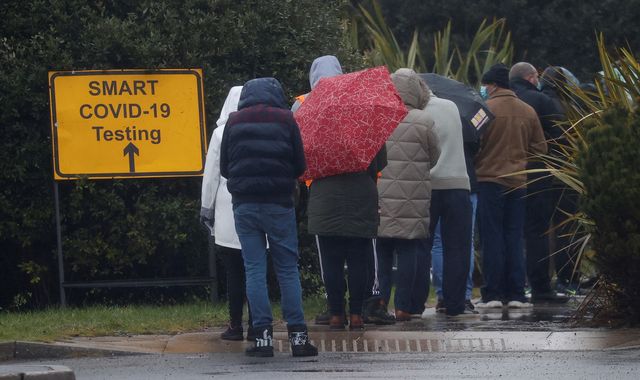
A lack of testing left the government "effectively blind" to COVID spreading across the UK, a report has found.
The UK was "not prepared" to deliver a test, trace and isolate system at the start of the pandemic, enabling the virus to spread "virtually unchecked" for the first three months of the crisis, the pandemic probe has concluded.
Baroness Heather Hallett's report said that even though scientists had developed an effective test by mid-January 2020, "there was no system of widespread testing, tracing or isolation for several months" and "COVID-19 was allowed to spread with deadly speed across the country".
On the issues facing testing, she said the abandonment of contact tracing and testing in the community in March 2020 was due to the UK's lack of tests, equipment and poor capacity to process them.
The failure to carry out widespread testing meant the "likelihood increased that more restrictive measures, such as lockdowns, would later be required", she said.
In her foreword to the 245-page report, Baroness Hallett said efforts to contain the virus early on "were doomed to fail" because test, trace and isolate system in the UK could only handle a relatively small number of cases.
"As the number of cases began to rise exponentially, capacity for testing, tracing and isolation was soon overwhelmed," she said.
She added that the "UK entered the Covid-19 pandemic woefully ill prepared to implement effective, nationwide test, trace and isolate systems".
The report also heavily criticised the government over its border control policy and said it was out of step with other countries and contributed to the spread of the virus in the UK.
"The decision not to implement widespread border control measures from the outset of the COVID-19 pandemic represented a missed opportunity by the UK government to try to slow the spread of infection by reducing the risk of imported cases," the study said.
The report said that though ministers "invested considerable time, effort and resources" into the system that did become "extremely effective" once they realised the scale of the crisis, their initial response had been hindered by a "lack of planning".
In contrast to the UK, other countries, including Singapore, Australia and Germany, were "comparatively better prepared to respond to the emergence of Covid-19", the report said.
"These countries experienced markedly lower death rates than the UK during the first six months of the pandemic," it said.
Baroness Hallett also said the failure to introduce 14-day self-isolation requirement for all incoming travellers to the UK "could have had a significant impact".
She also criticised the decision to allow "virtually unrestricted international travel in the first six months of 2020" had also contributed to the virus spreading further.
The report also found that those who were told to isolate "felt forgotten and let down by the lack of practical or financial support when trying to follow the rules".
This breaking news story is being updated and more details will be published shortly.
Please refresh the page for the fullest version.
You can receive breaking news alerts on a smartphone or tablet via the Sky News app. You can also follow us on WhatsApp and subscribe to our YouTube channel to keep up with the latest news.

(c) Sky News 2026: COVID was allowed to spread with 'deadly speed' and failure on borders was 'missed opportunity'
 'No further search and rescue activity' required after sunken boat found off Orkney - coastguard says
 Britain's biggest defence company to cut more than 1,000 jobs
 Hundreds of thousands of London transport users may have been hit by data breach
 Prince William and Kate meet India's PM Narendra Modi as they wrap up royal visit
 Muslims projected to outnumber Christians worldwide by 2035 - with majority of people in UK non-religious by 2070
 Woman, 19, dies after collision outside A&E department at Arrowe Park Hospital, police say
 Noel Clarke appears in court over alleged sexual offences