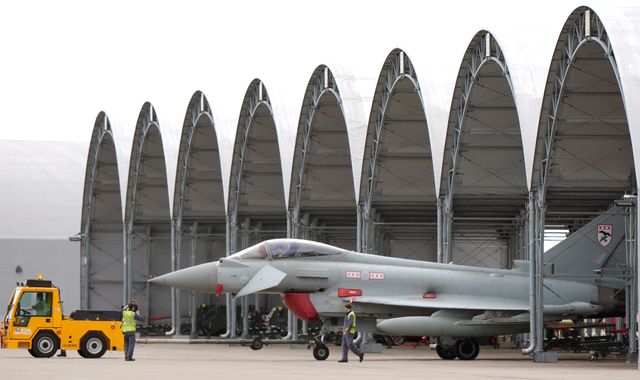
The Royal Air Force is moving aircraft to hangars and hardened shelters at night to protect them from possible drone threats, it is understood.
There are also thought to be plans to erect anti-drone nets around warplanes that remain exposed, such as by runways or at airbases that lack sufficient protection.
Such counter-drone netting is a common sight across Ukraine to help defend military equipment, critical national infrastructure and key roads from incoming Russian drones.
The moves by the RAF are a clear indication of how the UK's armed forces are strengthening their defences on the home front at a time of growing threats.
MI5 and the Ministry of Defence on Tuesday warned British companies involved in the supply of military kit to Ukraine that they are at an increased risk of sabotage by Russia.
Iran is also suspected of plotting to target RAF Fairford, an airbase in Gloucestershire that is used by the US Air Force.
That threat prompted the Pentagon to evacuate bomber aircraft from the site. The Americans have also moved warplanes away from a second UK airbase amid reports of another Iranian threat.
Details about the steps being taken by the RAF, which are also being reported by The Times, came as the chief of the air force underlined the importance of practising the dispersal of aircraft in case of conflict - a level of agility that was second nature in the Cold War.
Having warplanes scattered across multiple locations makes them a far harder target than if they are all condensed at a handful of bases.
Air Chief Marshal Sir Harv Smyth said the RAF was preparing for a scenario where "there is no sanctuary at home, you are fighting from the UK but you need to get on the move".
Speaking at an event on Tuesday evening, he said the construction over the summer of a new runway at RAF Brize Norton, the air force's main air transport hub, had meant his personnel had been required to disperse aircraft anyway.
But this is clearly regarded as a useful drill and one that will likely be rehearsed again.
"Through this summer we have built a whole new runway whilst dispersing all those airplanes from Prestwick [an RAF base in Scotland] to Boscombe Down [a military airfield in Wiltshire] and we have not missed a heartbeat," Air Chief Marshal Smyth said, speaking at the Freeman Air and Space Institute.
"As a service, we have proved that if we need to, we can take what people would have called 'eggs in one basket' and spread it across the length of the United Kingdom and keep operating.
"That was a big test for us and frankly the team nailed it.
"We need to do more of that, this idea of just being as ready as we can with all of the tools that we have optimised for what we think the fight might be."
During the Cold War, the RAF - as well as the army and the Royal Navy - would regularly drill for the potential for all-out war.
It required a level of readiness - including the ability to disperse aircraft at a moment's notice - that was gradually eroded after the Soviet Union collapsed.
While military chiefs are once again preparing the military for conflict, the size of the defence estate has drastically shrunk in the intervening decades because of cuts.
It means, for the RAF, there are far fewer operational air bases for their warplanes to disperse to than in the 1980s - though the force always retains the ability to use any airfield, including civilian ones, at a time of national emergency.
In addition, money has been invested into airfields at Boscombe Down and elsewhere for them to receive heavy transport planes and other aircraft.
Read more from Sky News
Energy bills to soar as new price cap announced
Multiple chances missed to protect two-year-old murdered by his grandparents, report finds
The RAF's readiness for conflict on the home front was tested back in March in a two-week "homeland defence training" exercise.
Few details were released about what took place and what vulnerabilities were potentially uncovered, however.
In a statement at the time, the air force said the exercise - dubbed Agile Warrior - was "designed to rigorously test the RAF's ability to protect the United Kingdom in an increasingly contested and volatile global security environment and forms a critical step to ensuring the RAF remains ready to 'fight tonight' in defence of the nation".
The training required air and ground units at RAF stations across the UK to simulate the effects of cyber-attacks and incoming missile threats.

(c) Sky News 2026: RAF 'moving aircraft to hangars at night to protect them from drone threats'
 Two men charged over suspected burglary at William and Kate's Norfolk home
 Multiple chances missed to protect two-year-old murdered by his grandparents, report finds
 Raheem Sterling given suspended sentence for dangerous driving in Lamborghini
 Eurostar trains cancelled and delayed over 'unannounced strike action'
 'Misperceptions' on immigration widespread among public, study finds
 Man in court charged with murder of missing woman
 Release of unknown substance at Manchester concert could be linked to reports of robberies, police say