
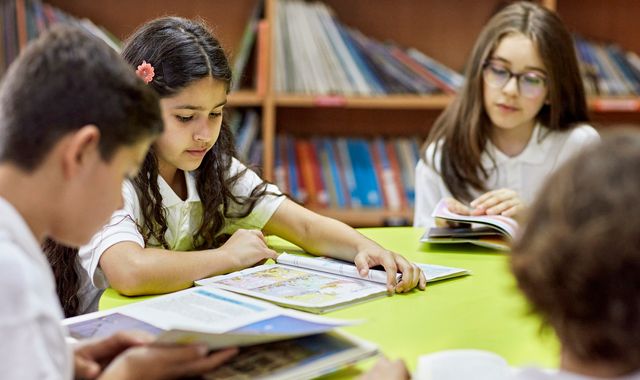
Young people in the UK are among the best performing in the world in science, maths and reading - but a major study has warned of a worrying decline in teenagers' ability to read and think critically.
The UK has climbed into the top 10 in the latest Programme for International Student Assessment (Pisa), which assessed more than 760,000 15-year-olds across 91 countries and economies.
The Pisa tests are run by the Organisation for Economic Co-operation and Development (OECD) and rank the UK among only a handful of education systems in the top 10 across all three core subjects.
UK pupils scored 511 points in science, compared with an OECD average of 482. That was an improvement of 12 points since the previous assessment in 2022 - one of the strongest rises recorded. The UK also scored 494 in reading and 488 in maths.
Of the UK breakdown, England scored particularly well - with 516 points in science, 497 in reading and 492 in maths.
But the wider picture is far less positive.
Across OECD countries, reading scores have fallen by 28 points since 2015 - equivalent to more than a year of learning.
And the organisation says around one in five 15-year-olds now fails to reach the basic level of proficiency in science, reading and maths.
The decline is particularly concerning because reading is no longer simply about understanding a book or answering comprehension questions.
The OECD says students are increasingly struggling to evaluate information, make connections between different sources and think critically about what they read.
The proportion of so-called "hasty readers", pupils who rush through texts and give quick but incorrect answers, has almost doubled since 2018.
The report suggests the problem predates the COVID pandemic, with falling levels of reading for enjoyment and increasing reliance on digital content potentially contributing to the decline.
It also raises questions about the impact of smartphones and other devices in classrooms.
More than one in four students said their classmates were distracted by devices in most or every science lesson.
The OECD found that moderate use of technology for learning can be associated with stronger performance - but excessive use and digital distraction are linked to weaker outcomes.
Read more from Sky News:
Prince George starts first day at Eton College
Death of Nottingham attack victim 'potentially preventable'
Artificial intelligence presents another challenge.
The report warns that AI should support learning rather than replace the thinking students need to do themselves.
The message for schools is therefore not to reject technology, but to use it strategically, while protecting time for reading, concentration and independent thought.
And while the UK's performance will provide encouragement for policymakers, the OECD's findings suggest being near the top of the international rankings does not mean the problems facing classrooms can be ignored.
As AI and digital technology transform education, the challenge may be less about giving children access to information - and more about ensuring they still have the skills to question, critique and analyse it.

(c) Sky News 2026: UK teenagers ahead in science, maths and reading
 The UK's trade ban with Israeli settlements explained
 RNLI trying to 'understand decision to deny access' to boat carrying migrants
 Death of Nottingham attack victim 'potentially preventable', inquiry hears
 Two more people arrested over 'infamous' illegal dump site in Kidlington
 People who spread asylum seeker disinformation which led to fire at Glasgow flats will be 'pursued' by police, John Swinney vows
 14 men go on trial in Paris over Channel crossing that left over 30 dead five years ago
 Patients left with 'horrific' disabilities after surgery at hands of disgraced Sam Eljamel, inquiry told
 Three people arrested after fatal 'hit-and-run' crash near Edinburgh Airport