Higher levels of tariffs and increased geopolitical threats are a "major risk" to the global economy, the International Monetary Fund (IMF) has said.
It comes as US President Donald Trump is once again threatening to raise taxes imposed on imports, this time against eight European countries for not supporting his plan to take over the semi-autonomous Danish territory of Greenland.
Tariffs of 10% would take effect on 1 February for Denmark, Norway, Sweden, France, Germany, the UK, the Netherlands and Finland, a rate that would then climb to 25% on 1 June if no deal was in place to purchase Greenland.
Money blog: Big energy providers named among worst in new rankings
On the day that Washington-based UN financial agency the IMF published its six-monthly analysis of economic trends, called the World Economic Outlook (WEO), its chief economist Pierre-Olivier Gourinchas was asked about the latest trade threats from the US.
"This volatility is bad for business decisions. It's bad for investment. It's bad for consumption. It leads to a state of uncertainty. And for the increased precautionary saving. So it affects global activity downward," Mr Gourinchas said.
"So, going forward, this is a major risk. This is something that could mature and impact growth if we have higher levels of tariffs, if we have higher levels of geopolitical tension."
The harms could come to both the US and countries hit with the tariffs, he said.
"Who stands to lose more, that's the right way to frame it, because as we all know, there are no winners in a trade war and that's the thing to remember."
"Of course, it's also hurting other countries, so this is a situation where tariffs and retaliation, that increase in tariffs, would put downward pressure on global activity".
Read more from Sky News:
Analysis - Unleashing Europe's most powerful trade weapon on US not unthinkable
What about the UK economy?
As one of the countries threatened by the levies, the UK would be directly harmed.
Research firm Capital Economics estimated the tariffs would "add to the existing pain" for UK car and pharmaceutical manufacturers.
In a worst-case scenario, they could reduce UK economic growth by 0.3% to 0.75%.
"The long-term political and geopolitical consequences would be much greater," said Paul Dales, Capital Economics' chief UK economist.
"One could be that the UK is nudged closer to the EU, at least when it comes to trade in goods."
For now, the IMF has left its forecasts for the UK economy unchanged.
A key measure of economic growth, gross domestic product (GDP), is forecast to be 1.3% in 2026 and 1.5% in 2027, according to forecasts completed in December.
Price rises are expected to slow with inflation anticipated to fall to 2% at the end of this year, the IMF added.
This, however, is due to lower wages as unemployment rises.
But with lower inflation comes lower borrowing costs. The IMF has expressed what many traders believe, that the Bank of England will continue to lower interest rates through 2026.
Market reaction
As seen in times of other tariff threats, there's been a stock market sell-off.
In the UK, that's meant the benchmark stock index, the FTSE 100 index of most valuable London Stock Exchange-listed companies, was down more than 0.5%.
In Europe more broadly, it's a sea of red with big losses being recorded, particularly in Scandinavian countries.

(c) Sky News 2026: 'Major risk' to global economy from increased tariffs, IMF says
 What we know so far about the fatal train crash in Spain
 Trump's extraordinary letter to Norway about Greenland - in full and fact-checked
 The misunderstanding that may have triggered Trump's latest Greenland threat
 Greenland crisis: Unleashing Europe's most powerful trade weapon on the US was previously unthinkable - not anymore
 Hackers target Iranian state TV as exiled crown prince tells military to 'join the people'
 Vladimir Putin invited to join 'Peace Council' for Gaza, Kremlin says
 Zootropolis 2 becomes Hollywood's highest-grossing animated film of all time
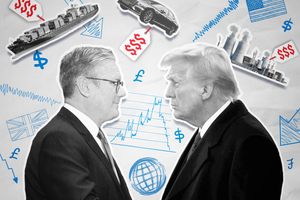 Greenland row: What Trump tariff threat could mean for Europe's economies
 Ring Nebula: What is mysterious iron 'bar' in space?