America aims to maintain the momentum of the Gaza peace process, which is why Steve Witkoff ushered in the second phase of the ceasefire before the first had actually come to an end.
Not all the hostages have been returned. Those who were alive have all come back, but the remains of Ran Gvili are still somewhere in Gaza, and there are, as yet, no signs that Hamas are about to hand them over. Nothing, it has been said, could happen until they did.
But the passage of time exerted political pressure and fears grew that Hamas was using this time to strengthen itself again.
So, through a social media message, Witkoff has decided that the wait is over. Phase two, he announced, had been launched.
So what actually happens now? If that was your question, it's the right one. But the answer isn't obvious.
Three Gaza governing bodies
We do know that three different administrative bodies will be created.
One will be filled with Palestinian technocrats and will be in charge of administering Gaza. At its head will be Ali Shaath, brought up in Gaza and later educated in Belfast, who is an expert in urban planning.
Then there is an executive committee, which will contain Witkoff himself, along with Jared Kushner and other American and Israeli officials, some of whom were involved in organising the highly controversial Gaza Humanitarian Foundation - the aid distribution vehicle widely accused of creating a system that was both inefficient and dangerous.
And then at the top of the tree will be the so-called Board of Peace, to be chaired by Donald Trump.
Its membership is still unknown, but the American president has extended invitations to world leaders, including Keir Starmer and Italy's Giorgia Meloni. Trump, typically, is bullish about its power; others seem more cautious about signing up without knowing what exactly is involved.
Challenges include disarming Hamas and withdrawal of Israel
Then there are the towering challenges that lie ahead.
Under the peace plan, Hamas is supposed to disarm. Does that mean all weapons, or just heavy ones? What actually counts as Hamas? What happens to those weapons? And who's checking?
Then there's the promised Israeli withdrawal. There is, frankly, no chance of that happening while Hamas is still armed, and possibly not as long as the group even exists.
Which means that Israel will still occupy half of the Strip's land and will still reserve the right to kill those it says pose an immediate threat. Over 400 people have been killed in Gaza since the ceasefire began.
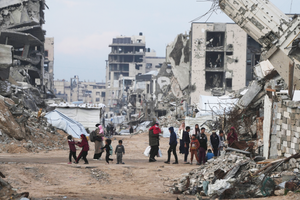
And I haven't even mentioned the colossal construction effort that will be required to rebuild Gaza - homes, roads, schools, hospitals, sanitation, power, water treatment.
A large percentage of the population, which numbers more than two million, is presently living in tents or ruined buildings, without the most basic of facilities to sustain everyday life.
Read more from Sky News:
US to suspend immigrant visa processing for 75 countries
Dozens killed in Thailand as crane falls on to moving train
So will that start, overseen by Mr Shaath and his Palestinian colleagues? Or will construction be blocked by Israel until, say, Hamas disarms? And if that happens, will Trump push for action, tolerate a stalemate or open the door for more military intervention?
We simply don't know.
Phase two looks like an ironclad set of pledges, but in fact it is really more a blend of aspirations, ambitions, ideas and negotiating positions. It will be complicated, protracted and unpredictable. What it won't be is easy.

(c) Sky News 2026: Phase two of Gaza peace plan will be complicated, protracted and unpredictable
 'It's like a road closure' - Uganda's president on shutting down the internet as his country votes in election
 Is America surrendering Antarctica to its rivals?
 Denmark says 'fundamental disagreement' remains with Trump - but agrees to high-level talks over Greenland
 US launches phase two of plan to end Gaza conflict, including creation of transitional authority
 'Everyone was being shot in the head': Iranian woman who fled Tehran describes killings and crackdown
 International Space Station astronauts back after first ever emergency return
 Iran's regime could fall, says Trump - as US president considers intervention
 US to suspend immigrant visa processing for 75 countries
 Ten British 'far-right activists' banned from France over 'reconnaissance and destruction' against small boats